
Deep learning for forensic personal identification and disaster victim identification
Can an unknown deceased individual be identified by comparing a postmortem CT scan with chest X-rays acquired during life?
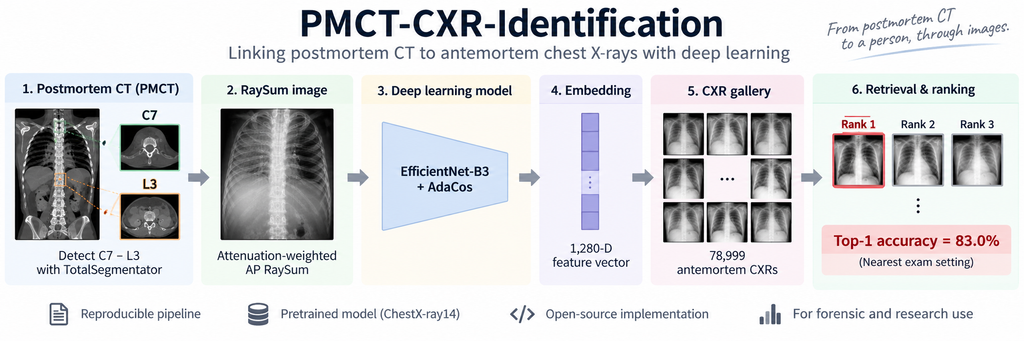
We developed a deep learning–based method for forensic personal identification by matching postmortem computed tomography (PMCT)–derived RaySum images with antemortem chest X-rays (CXRs).
The study was published in Forensic Science International in 2026.
Published article
Ryusei Inamori, Tomoya Kobayashi, Takaya Kawasumi, Hidekazu Kanayama, Yeji Kim, Yongsu Yoon, Yohei Inaba, Akihito Usui, Eichi Takaya, Yoshikazu Okamoto.
Development of a deep learning–based model for personal identification using postmortem CT and antemortem chest x-rays.
Forensic Science International. 2026;388:113087.
DOI: https://doi.org/10.1016/j.forsciint.2026.113087
PubMed: https://pubmed.ncbi.nlm.nih.gov/42543040/
Source code: https://github.com/ryusei-inamori/PMCT-CXR-Identification
Why this study matters
Personal identification is a critical component of forensic investigation and disaster victim identification (DVI).
In mass disasters, conventional identification methods such as fingerprints, dental records, and DNA analysis may not always be immediately available. Medical images acquired before death represent another potentially valuable source of identifying information.
Chest X-rays are among the most commonly acquired medical images. However, after death, an identical chest X-ray may not be available.
Our study therefore investigated whether a chest-like projection image generated from postmortem CT could be matched against a large database of antemortem chest radiographs using deep learning.
Study overview
The retrospective study included:
- 1,385 deceased individuals
- Postmortem CT images
- Antemortem chest X-rays
- 78,999 additional non-matching chest X-rays used as distractors
For each PMCT examination, the body trunk from the seventh cervical vertebra to the third lumbar vertebra was extracted.
An anteroposterior RaySum image was then generated from the three-dimensional CT volume to create a projection image resembling a conventional chest radiograph.
An EfficientNet-B3 deep learning model using AdaCos metric learning was used to extract image representations.
Each PMCT-derived RaySum image was then used as a query for one-to-many (1) image retrieval against the chest X-ray gallery.
Key results
The highest retrieval performance was achieved when all available antemortem chest X-rays were included in the gallery.
| Rank | Correct identification rate |
|---|---|
| Top-1 | 83.0% |
| Top-5 | 90.6% |
| Top-10 | 93.2% |
| Top-20 | 95.2% |
| Top-50 | 97.5% |
This means that, despite searching a gallery containing tens of thousands of unrelated chest X-rays, the correct individual was ranked first in 83.0% of cases and within the top five candidates in 90.6% of cases.
We also found that chest X-rays acquired closer to the date of death provided substantially better identification performance than older examinations.
Top-1 identification increased from 54.2% with the oldest available examination to 78.9% with the nearest-date examination.
These findings indicate that longitudinal anatomical and pathological changes can influence cross-temporal medical image identification.
Potential application to disaster victim identification
The goal of this approach is not to replace established forensic identification methods.
Instead, PMCT-to-CXR matching could be used as a candidate retrieval and prioritization system.
For example, when an unidentified deceased individual undergoes PMCT, the CT volume could be converted into a RaySum image and compared against a large archive of historical chest X-rays.
The system could then return a small number of high-ranking candidates for subsequent detailed forensic verification.
Such an approach may be particularly useful in mass disaster victim identification, where rapid screening of large numbers of individuals and medical records may be required.
Open-source implementation
A reproducible implementation of the PMCT-to-CXR identification pipeline is publicly available on GitHub:

The repository includes:
- PMCT preprocessing
- anatomical localization
- RaySum generation
- EfficientNet-B3 + AdaCos embedding
- cosine-similarity retrieval
- Oldest / Nearest / All examination evaluation
- Top-k identification analysis
- reproducibility documentation
Clinical PMCT and chest X-ray data are not publicly distributed because of privacy and ethical restrictions.
Research keywords
Forensic personal identification, forensic imaging, forensic radiology, disaster victim identification, DVI, postmortem CT, PMCT, postmortem imaging, chest X-ray, chest radiography, antemortem imaging, artificial intelligence, deep learning, metric learning, medical image retrieval, cross-modal image retrieval, RaySum, forensic AI.
Citation
If you use this work or the accompanying code in academic research, please cite:
Inamori R, Kobayashi T, Kawasumi T, et al. Development of a deep learning–based model for personal identification using postmortem CT and antemortem chest x-rays. Forensic Science International. 2026;388:113087.
https://doi.org/10.1016/j.forsciint.2026.113087